Last month, Major League Soccer announced that their annual schedule would be changed so that it would align with other leagues around the world. This means that MLS teams will now be playing games later in the year and therefore in cold weather. For this reason, the MLS team in Washington, DC, named DC United, is asking for $300M so that a roof can be added to their home venue, Audi Field. According to the CEO of DC United, this money is “necessary” because the team will be playing more matches in the cold and because this addition to Audi Field is “the next steps in our partnership”…whatever the hell that means.
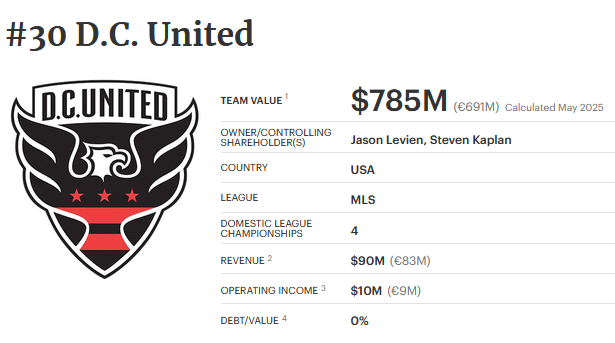
Thankfully, most media around DC seem to be questioning this request. One DC blog correctly summarized all of this as United demanding “hundreds of millions of taxpayers dollars to pay for improvements.” The Washington Post wrote an editorial calling this deal “unnecessary corporate welfare.” Why are taxpayers being asked to pay the costs of a private business that made at a minimum $12M last year? Is it that crazy to make DC United liable for their own renovation costs…just “like every other business and homeowner” in DC? One city councilmember, Elissa Silverman, bluntly asked the CEO of United how he could explain why a profitable and private business would need taxpayer money in today’s environment. His answer was the same one that teams always give in response to this. Apparently, the team believes that giving $300M of taxpayer money will “long-term…continue to put dollars back into the city.” There was no explanation on how or why this would occur. I would love to see someone explain to me how this roof would somehow add money to the city wallet.
But what makes this request even more appalling is that Washington, DC, is in the middle of a massive financial hole. City leaders are currently facing a massive budget shortfall even with a long list of major city projects that require funding. During a recent city hearing, one person from the D.C. Fiscal Policy Institute reminded city officials that in the previous week, they held a meeting to try to figure out how the city would be able to “close an estimated budget deficit of more than $600 million” for 2027. Last year, the city was forced to take out $150M from reserves to pass a balanced budget.
But that hasn’t stopped city officials from spending. Oh, no. Over the last few months, city officials have given nearly $700 million for upgrades to Washington Nationals Park, $515 million for Capital One Arena improvements, and roughly $1 billion for the Washington Commanders’ new stadium. How are they paying for these sports projects? Bonds. These bonds will be due and not that far in the future. Last week, it was reported that all of this spending by the DC Council is likely to “bring the city to the brink of its debt cap by fiscal 2032.” As the Washington Business Journal noted, city officials are spending massive amounts of money that “will have to be paid back for decades to come.”
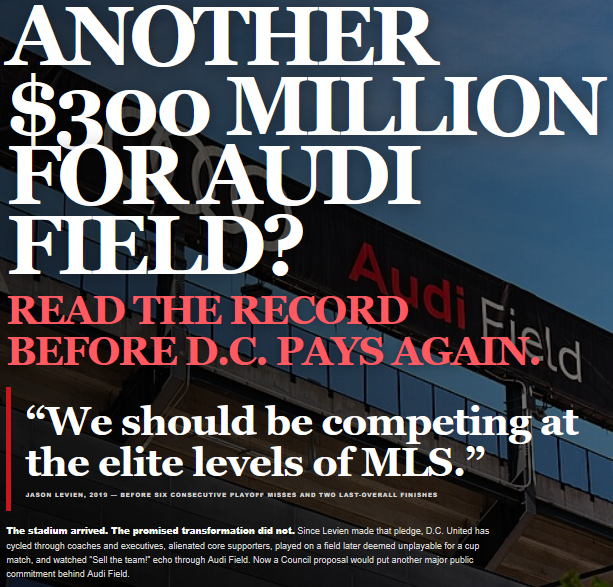
I agree. Spend, Spend, Spend! We are talking about the local sports teams. Give them whatever they want! Will it worsen DC’s bond rating and therefore make the costs continue to go up? Sure. Will reaching its debt limit stop the city from spending on new projects like “parking garages, infrastructure or other economic development projects”? Of course. Will the city, because of its spending amounts, continue to have hearings in the near future where they propose “potential tax hikes that could help to close the gap”? Oh yes. Decisions like this show just how much sports teams are looked upon as more important to the local leaders than the taxpayers they represent.
But here is the most essential detail to keep in mind. Before the stadium was constructed in 2018, the city gave the team a LOT of help to get it built. The team essentially got the land for free, with $150M to prepare the stadium site and a lease agreement that called for the team to pay $1 dollar every year for 30 years. In addition, a lease agreement was signed between the team and city. As the D.C. Fiscal Policy Institute found out, this lease agreement spells out clearly who must pay for future renovations:
The 2015 ground lease agreement between the District and the team makes clear that the DC is not responsible for stadium renovations. It states that the “District will not be obligated to incur any expense or improve, reconstruct, alter, repair or maintain any portion of the Stadium, the Adjacent Improvements, Adjacent Land or the Stadium Land.” – DCFPI, 10/23/26
If the team wants to put a roof on their stadium, WHY ARE THEY NOT PAYING FOR IT THEMSELVES? Anyone who thinks that adding this roof will somehow create magic amounts of money is kidding themselves. Not only do new venues not create money for cities/states, but additions to these venues are even less likely to somehow produce new money.
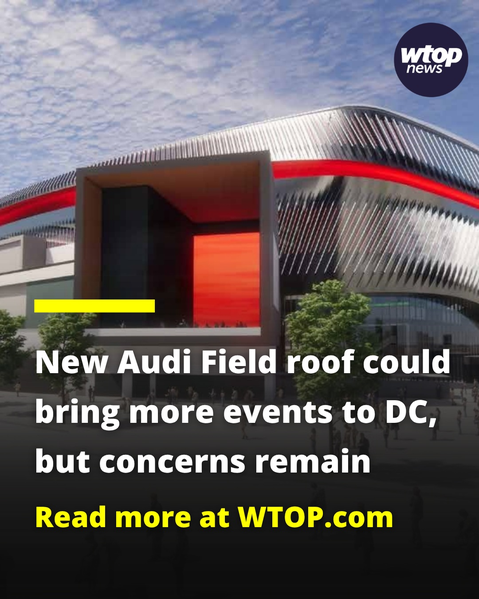
To top all of this off, one of the co-owners of DC United decided to throw in a threat of relocation if the team isn’t given what they want:
“Without going so far as to say the team’s thinking of leaving the District, (D.C. United co-owner Jason Levien) also raised the prospect the it could be lured to other jurisdictions if council opts not to act on the proposal…’We see the under-venued nature of Washington, D.C., and I think that, if we don’t do this, there’s going to be a big push, as there was two years ago, to put an arena in Virginia or Maryland’ Levien said.” — BizJournal, 10/23/26
Last thing, when the city was debating whether to build this new stadium years ago, several officials pointed out that building this soccer stadium would take away almost $100M from the city budget (which could have been used for multiple schools and other city fixes). In response, the public was told that building this new soccer stadium would allow the city to “reap the economic benefits” of its construction. That never happened. So, why should anyone believe that it will happen this time?