
This week, I saw a story in the Phoenix Business Journal that discusses a recently released study that emphasized how a recent women’s final four tournament held in the area “generated huge economic impact” for the state of Arizona. Apparently, this tournament created “$42.2 million for Arizona’s GDP” (Gross Domestic Product) for Phoenix, while the State of Arizona saw a “$71.5 million overall impact.” However, if you read over the report, there appears to be a lot of information missing. The report admits to JUST using “new dollars” that Arizona may have received during the tournament. What about expenses? What about the substitute effect? Or any other part of putting together an actual economic impact report? Missing.

Unsurprisingly, I then saw who wrote the report…the Seidman Research Institute (“SRI”). If you aren’t aware, SRI is operated out of Arizona State University by a man named Dennis Hoffman. For many years now, the SRI has been the place to go to if you want the public to know that some local event made the city and state millions and millions, truth or not, be damned. As the Arizona Daily Independent writes, the SRI is the “group often commissioned by professional sports teams in Arizona to calculate the economic impact” of their current or new sports venues. Or my favorite is the way that Neil deMause describes SRI…as the “business consulting firm that previously insisted spring training games are worth a bazillion dollars despite actual data showing they don’t increase the economy at all.”
These are just a few of the many examples involving SRI:
- In 2015, Arizona hosted the NFL Super Bowl. Several weeks later, the governor of Arizona stood at a podium and announced that the recent Super Bowl had a “gross economic impact of $719.4 million” for the region, according to a study done by the SRI. However, as NBC San Diego found out, the study was commissioned and paid for by the…Arizona Super Bowl Host Committee. The report also forgot to include a number of rather basic things. For example, the report forgot to include any expenses that the city spent on the event (which can be many millions), the report didn’t include any resident and local business spending, and the report forgot to include any figures for police and traffic workers (which can reach $50M per other cities hosting the Super Bowl).
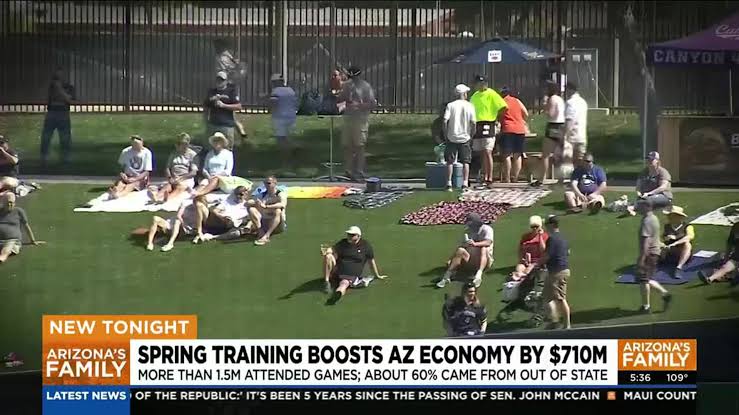
- Every year, MLB teams look towards Arizona cities to upgrade or build new spring training facilities. Every few years, the SRI will release a new report that increases how much money that spring training facilities are bringing to the area. Just forget that any actual evidence shows that these spring training games bring close to $0 dollars to the city’s bottom line.
- In 2023, spring training games brought in around $415M of economic impact!
- In 2024, spring training games brought in over $700M of economic impact!
- In 2026, spring training games brought in over $800M of economic impact!

- The Phoenix Open has quite the history of taking public money under the table; however, as the tournament gets bigger every year, they have needed to request some city/state financial help. Not to worry! SRI is here! According to a 2018 report, the golf tournament adds “$389 million into Arizona’s economy.”
- In 2019, the city of Scottsdale wanted some publicity for hosting several smaller events. They paid SRI for a report and got one. Apparently, Scottsdale hosting collector car auctions, a horse show, and a polo championship brought in “estimated gross sales of $111.7 million for Scottsdale” and $180M more for surrounding areas.
- Just last year, the Arizona Diamondbacks, an MLB team, wanted $300M of taxpayer money for upgrades to their ballpark. They put up the SRI light in the sky, and SRI came to help at once. Then, an SRI study came out claiming that a recent MLB playoff run “generated $107.6 million in local economic activity.” As always, expenses were never included, nor were most parts of what an actual economic impact study would include.
But the biggest SRI story came three years ago. In 2023, the Arizona Coyotes, an NHL team, wanted to build a new arena. So, they proposed a $2.1B project that would include a new arena and a surrounding entertainment district. While every other independent study strongly suggested that taxpayers would be on the hook for many millions of dollars of debt payments and interest, the SRI shockingly released a report stating the exact opposite. In fact, SRI found that this new arena would create 35% more jobs than previously thought and that new tax revenues would be “significantly” higher.
Wait a second, do we know who paid for this SRI report? Yes, we do. The city of Tempe and the owner of the Arizona Coyotes are the ones who paid for it. Isn’t it also odd that whenever a media member tried to get the hard data to which SRI used to come to their conclusions, they were told that the information was “not publicly available.” What bad luck.
So why was this report written and released? Because the city wants to host future Final Four tournaments. In the story, it is mentioned how Phoenix wasn’t selected for any men’s final four through 2036. But Phoenix is a finalist for a woman’s final four between 2032 and 2036. In fact, there is this line in the story:
“Data from the study was released the day after the NCAA unveiled Phoenix as a finalist city for a future Women’s Final Four.” – Phoenix Business Journal, 10/28/26
That kind of reminds me of how the SRI released a report right after the 2024 men’s final four was held in Arizona. It found that this tournament brought in $430M. Though it is odd how neither the 2024 nor 2025 budgets of the city or state saw any of this increase when their yearly budgets were released.


